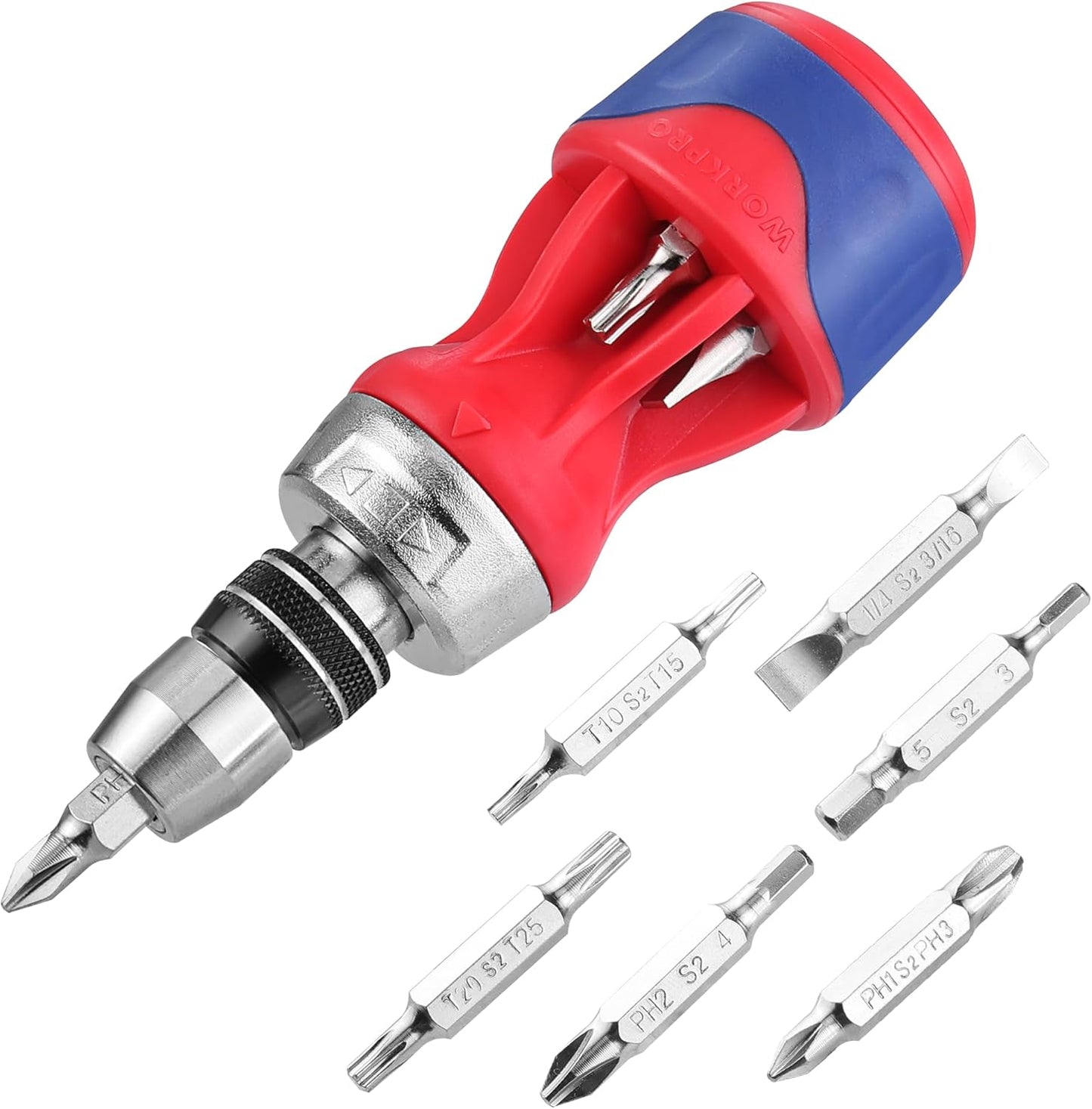
WORKPRO 12-in-1 Ratcheting Screwdriver – Home Office Tool for Remote Workers Tinkering at the Desk
WORKPRO 12-in-1 Ratcheting Screwdriver – Home Office Tool for Remote Workers Tinkering at the Desk
Couldn't load pickup availability
Why you'll love it
- Replaces 12 individual drivers with one compact tool, eliminating clutter in tool drawers and bags
- Ratcheting mechanism with forward/reverse/lock switch cuts down on time and wrist fatigue versus manual screwdrivers
- Quick-load auto-locking allows true one-handed bit changes when the other hand is holding a workpiece
- Bits store inside the handle so nothing is lost and the tool is EDC-pocket-friendly
- S2 steel bits provide professional-grade durability over standard chrome-vanadium
- Stubby variant option delivers access into recessed screw holes that full-size drivers cannot reach
Perfect for
- Furniture assembly and disassembly with quick bit swaps
- Electronics and appliance repair (covers Phillips, slotted, square, and Torx fasteners)
- Bicycle and outdoor gear field repairs
- Tight-space fastening in Stubby variant where full-size ratchets won't fit
- Everyday carry for quick fixes at home, work, or on the go
Frequently Asked Questions
Will the ratcheting mechanism actually save me time on repetitive jobs?
Yes. The forward/reverse/lock switch lets you drive fasteners continuously without resetting your grip, which is the main time-saver on tasks like assembling flat-pack furniture, installing outlet covers, or working on a panel of similar screws. Most users report noticeably less wrist fatigue on jobs with 20 or more screws.
Is the quick-load auto-locking really one-handed, or is that marketing hype?
It is genuinely one-handed in practice. You pull back the collar, the bit pops out, you insert a new bit, and the collar snaps forward to lock it in. The whole swap takes about two seconds, which means you can hold a workpiece steady with your other hand and never set the tool down.
Can I use this in tight electrical panel spaces where a full-size driver will not fit?
That is exactly what the Stubby variant was designed for. Its short shaft reaches into recessed screw holes, crowded breaker boxes, and tight equipment enclosures where a standard-length screwdriver physically cannot go. For electricians, it often becomes the most-used tool in the pouch.
Does the internal bit storage slow down the workflow?
In practice it speeds it up. Because bits live inside the handle, you never walk back to a tool bag or truck to find the right one. The trade-off is you only carry 6 bits at a time, but those 6 cover the vast majority of fasteners you will encounter on a typical service call.
Is the 1/4 inch hex shank compatible with the bits I already own?
Yes. The driver uses a standard 1/4 inch hex quick-change shank, which is the industry standard. Any power-driver bit you already own from another brand will fit, so you are not locked into a proprietary bit ecosystem.
Is this a good upgrade from a basic non-ratcheting multi-bit screwdriver?
It is a meaningful upgrade. A non-ratcheting multi-driver requires you to flip the tool with every half-turn, which is slow and awkward. The ratcheting mechanism in this WORKPRO is a real workflow improvement, especially on longer jobs.
How does this compare to carrying a full set of individual nut drivers for appliance repair?
A full set of individual drivers is bulky, easy to lose, and tedious to flip through. The 12-in-1 replaces 12 separate tools in one, and the bits are always organized inside the handle. For appliance repair specifically, the included square bits (SQ1, SQ2, SQ3) cover most modern appliance fasteners that Phillips drivers cannot grip.
Is the handle comfortable enough for all-day professional use?
The nylon and TPE ergonomic grip is designed to reduce hand fatigue and improve torque transfer compared to a hard plastic handle. For full-day heavy industrial use, a specialty high-torque driver may still be preferable, but for typical maintenance, HVAC, and electrical work, the comfort level is more than adequate.
What if I am left-handed, does the ratcheting switch work the same way?
The forward/reverse switch is a small top-mounted slider that works identically regardless of hand dominance. There is no side-specific orientation, so left-handed users get the same functionality as right-handed users.
Will the S2 steel bits actually outlast standard chrome-vanadium bits on the job?
Yes. S2 steel is a tool-grade impact-resistant steel with significantly higher hardness (typically 58-62 HRC) compared to chrome-vanadium (typically 50-55 HRC). On professional jobs with hundreds of screws, the difference in wear and cam-out resistance is very noticeable.
Is this a worthwhile investment for a serious DIYer, or is it more of a casual tool?
It sits in a useful middle ground. For occasional household tasks, it is overkill. For serious DIYers who tackle furniture builds, appliance repair, and home renovation projects, the ratcheting mechanism, the bit variety, and the build quality make it a tool that gets used daily rather than occasionally.
Can I use the Stubby variant for precision electronics work without stripping small screws?
The Stubby variant has a shorter shaft, which gives less precision on tiny screws compared to a full-length precision driver. For phone and laptop work, a dedicated precision screwdriver set is still the better choice, but for small electronics, appliances, and game consoles, the Stubby works well.
How much torque can this driver actually deliver before the ratchet slips?
The ratcheting mechanism is rated for typical hand-tool torque, which is more than enough for household screws, most furniture assembly, and light appliance work. It is not designed to break loose seized automotive bolts, and attempting to do so can damage the ratchet teeth over time.
Does it lock solidly for use as a non-ratcheting screwdriver?
Yes. The center lock position disables the ratchet entirely, turning it into a fixed driver for applications where you need full torque transfer without any ratchet play. This is useful for final tightening or for breaking loose a stubborn fastener.
Will this hold up to being tossed in a service vehicle toolbox every day?
The internal bit storage means the bits cannot rattle loose or get lost, and the solid handle construction holds up to typical job-site abuse. It is not indestructible, but for daily professional transport in a truck or van, it is built to handle the routine bumps and grime.
Is there a learning curve to using the quick-load mechanism efficiently?
Most users pick it up in under a minute. The motion is intuitive: pull the collar back, the bit ejects, insert the new bit, release the collar. The lock is tactile and audible, so you feel and hear when the bit is secure before you start turning.
How do I change a bit in the WORKPRO 12-in-1 screwdriver?
Pull back the quick-load collar on the front of the handle, and the currently installed bit ejects automatically. Insert the new bit and release the collar; the auto-locking mechanism grips the bit firmly. The whole operation takes about two seconds and can be done one-handed.
What are the 12 bit sizes included with the screwdriver?
The set includes 6 double-ended S2 steel bits covering SL4/SL5 slotted, PH1/PH3 Phillips, SQ2/PH2 square and Phillips combo, SQ3/SQ1 square, T10/T15 Torx, and T20/T25 Torx. Together these handle the vast majority of household, appliance, electronics, bicycle, and automotive fasteners.
How do I use the ratcheting function and what do the switch positions mean?
The top-mounted switch has three positions: forward (drive screws in), reverse (loosen screws out), and center lock (fixed driver with no ratcheting). Slide the switch to the direction you need, and the handle will turn the bit continuously in that direction without requiring you to reset your grip.
Are the bits compatible with my cordless drill or impact driver?
Yes. The bits use the standard 1/4 inch hex shank, which is the universal fitment for virtually all cordless drills, impact drivers, and driver bits on the market. You can pull a bit out of the WORKPRO handle and use it in your power tool, then return it to the handle when finished.
Will this work with security Torx or specialty bits I buy separately?
Yes, as long as the security or specialty bits use a 1/4 inch hex shank. The auto-locking collar accepts any standard 1/4 inch hex bit, so you are not limited to the included 12 sizes. The most common add-ons for users are longer bit extensions and security Torx bits.
What is in the box when I order this screwdriver?
You receive the ratcheting multi-bit screwdriver handle, 6 double-ended S2 steel bits (12 fastener types total), and the bits are pre-loaded inside the handle. No batteries, chargers, cases, or additional accessories are required to start using the tool.
Do I need to buy anything separately to start using it?
No. The screwdriver is fully functional out of the box with the included 12 bit types, and the internal storage means nothing is missing. If you want to expand your bit selection later, any standard 1/4 inch hex bit from any hardware or tool brand will work.
Is the handle safe to use around live electrical work, or is it insulated?
The handle is not rated for use on live electrical circuits. While the nylon and TPE materials provide some insulation, you should always de-energize circuits and use a tool specifically rated and certified for electrical work (typically rated to 1000V) when working near live conductors.
How long will the S2 steel bits last with normal use?
With typical household and even professional use, the S2 steel bits will last for years before any meaningful wear, cam-out, or rounding occurs. S2 steel is significantly harder and more wear-resistant than the chrome-vanadium steel found in budget bit sets, so longevity is one of the strongest features of this tool.
What is the difference between a multi-bit screwdriver and a precision screwdriver set?
A multi-bit screwdriver like the WORKPRO 12-in-1 uses standard 1/4 inch hex bits designed for household, furniture, appliance, and bicycle fasteners. A precision screwdriver set uses much smaller bits designed for electronics like phones, laptops, watches, and eyeglasses. The two tool categories serve different purposes, and most DIYers eventually own one of each.